

.webp)




Table of Contents
Introduction
Over the last 22+ years of building and scaling teams at ZealousWeb, one thing I’ve consistently seen is this—hiring is never just a process. It’s judgment. Even with structured interviews, scorecards, and defined evaluation systems, there is always a human layer that interprets context, intent, and potential beyond what a resume shows. Today, that layer is slowly being influenced by AI. And while that brings speed, consistency, and scale into hiring, it also shifts where decisions are actually being shaped in the process.
What’s interesting is how fast this shift has happened. A McKinsey report notes that when ChatGPT was released, it reached 1 million users in just 5 days—one of the fastest adoption curves we’ve ever seen. Their research also highlights that nearly 80% of jobs today can incorporate generative AI in some form of work activity, which tells you how deeply this is already embedded in how we operate.
And that’s where the real conversation begins. AI in hiring is already deeply embedded across functions like resume parsing, candidate matching, and even interviews. But here’s the catch AI doesn’t just improve decisions, it reflects and amplifies the logic it is trained on. So if that logic is incomplete or biased, it doesn’t stay contained. It scales quietly. That’s why ethics in AI-driven hiring isn’t a side discussion anymore; it sits right at the center of how fair, accountable, and trustworthy these systems actually are.
Through this piece, we will explore how AI is reshaping hiring, where ethical risks quietly emerge, and what it really takes to build systems that are not just efficient but responsible.
Defining AI-Driven Hiring
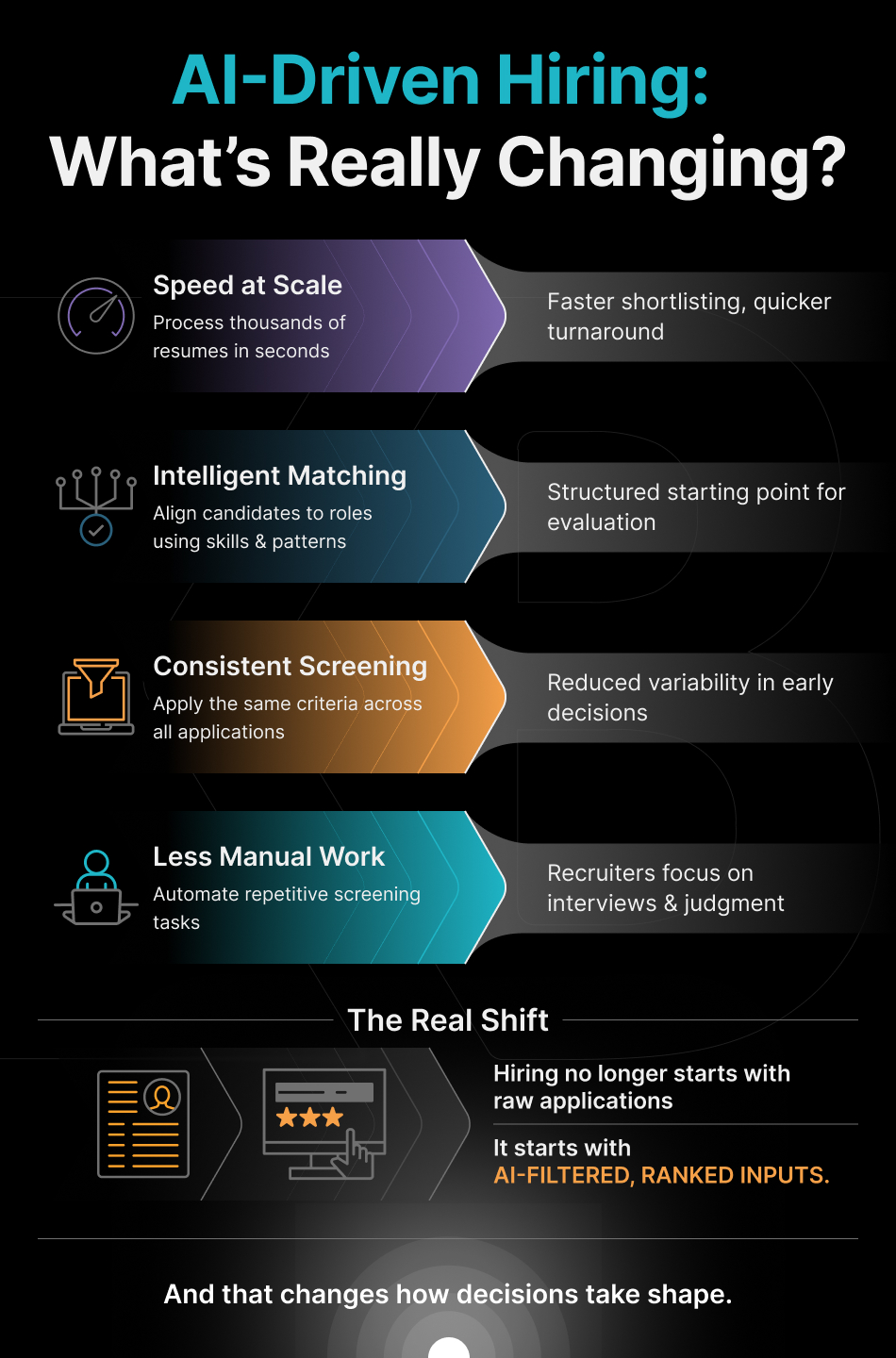
AI-driven hiring is changing how organizations discover and evaluate talent. It brings speed, structure, and scale into processes that were traditionally manual and intuition-led—especially in roles like marketing, where candidate volume, portfolio diversity, and subjective evaluation often make screening more complex. While this improves efficiency, it also subtly shifts where and how decisions begin to take shape in hiring. To understand this shift, it’s important to break down what AI actually brings into recruitment.
Let’s look at how this plays out in practice.
- Faster resume screening and shortlisting
AI can process large volumes of applications in seconds, helping recruiters filter out irrelevant profiles early—particularly useful in marketing roles where applications can range widely in experience, specialization, and portfolio quality. This reduces manual effort and improves turnaround time in the initial stages. - Automated candidate-job matching
Systems can map candidate profiles to job descriptions based on skills, keywords, and patterns—such as SEO, performance marketing, content strategy, or brand management. This creates a structured starting point for evaluation, especially in high-volume hiring. - Standardization of early-stage evaluation
AI helps apply consistent criteria across all candidates, reducing variability in initial screening—important in marketing hiring where subjective judgment often influences early decisions. This brings a level of uniformity that is difficult to maintain manually. - Reduced manual effort for recruiters
By handling repetitive screening tasks, AI allows recruiters to focus more on interviews, portfolio reviews, and creative assessment—areas that are critical when hiring for marketing roles. It shifts effort from filtering to evaluating.
What changes here is not just efficiency, but the starting point of decision-making. Recruiters are no longer always beginning with raw applications—they are often working with system-filtered and ranked inputs, which naturally influences how marketing talent is interpreted and evaluated downstream.
This shift in how decisions begin is not limited to hiring—it reflects a broader change in how work itself is evolving.
→ Read more on the evolving role of HR in agency culture
<h3>Actionable Insights</h3>Define role-specific criteria upfront—covering skills, tools, and experience—so AI screening reflects what success actually looks like in the role. Treat AI-filtered candidates as an initial layer, but ensure human evaluation focuses on deeper attributes like problem-solving, adaptability, and potential. Regularly review shortlisted and rejected profiles to ensure strong but non-traditional talent is not being filtered out early.
Placing Ethics at the Core
As AI becomes more deeply embedded in hiring, the conversation naturally shifts—from efficiency to responsibility. Most organizations adopt these systems with the right intent: to move faster, reduce manual effort, and bring consistency into decision-making. However, the way AI learns from historical data can quietly introduce bias, even when no one is actively designing for it. These issues rarely appear early—they tend to surface once the system is already operating at scale. By then, patterns are harder to detect and even harder to correct.
This is why ethics cannot remain an external checkpoint. It has to be built into how hiring systems are designed from the outset.
Where the Real Risk Begins in AI-Driven Hiring
The challenge with AI-driven hiring is not the technology itself, but the lack of visibility into how decisions are formed. As systems take over screening, filtering, and ranking, the reasoning behind outcomes becomes harder to trace. What appears as a structured, objective output is often shaped by hidden assumptions—embedded in training data, selection criteria, and model design. Over time, this creates a gap between intent and outcome. Organizations believe they are making fair decisions, while the system may be reinforcing patterns they never consciously chose.
What This Means for Hiring Systems Going Forward
If AI is going to play a meaningful role in hiring, then fairness, accountability, and transparency cannot be optional layers. They need to be built into the structure of the system itself. More importantly, while AI can inform decisions, it cannot be responsible for them. The ownership of hiring outcomes must remain clearly human-led.
Ethical Dimensions in AI-Driven Hiring
- Fairness and Transparency:Fairness today is not just about equal treatment—it is about understanding how decisions are made. When decision logic is unclear, outcomes cannot be explained or improved. Transparency ensures that hiring decisions remain visible, reviewable, and accountable over time.
- Candidate Dignity and Trust: Every candidate invests time and intent into the hiring process. When systems take over early-stage decisions, that effort can feel reduced to a data point. Maintaining dignity means ensuring that processes feel respectful and considered—not purely automated.
- Accountability in Decision-Making: As AI becomes part of the process, responsibility can easily become diffused. Without clear ownership, it becomes difficult to question or correct decisions. AI can guide evaluation, but accountability must always sit with the people making the final call.
How Ethical Risks Show Up in AI-Driven Hiring
Understanding these challenges is only the first step—applying them consistently requires a structured approach. I’ve created a practical checklist and audit framework to help teams evaluate and refine their hiring systems.
<h3>Actionable Insights</h3>Conduct regular audits of AI-driven hiring decisions to identify hidden bias and misalignment with intended hiring outcomes. Establish clear ownership for reviewing and validating system outputs so accountability remains human-led. Build transparency into the process by documenting decision criteria and making early-stage filtering logic explainable and reviewable.
Balancing Human Judgment with AI
Hiring has never been just about process—it has always been about judgment. That’s where the real shift with AI is starting to show. While these systems bring speed and structure into the workflow, they also begin influencing how decisions are formed much earlier than most teams anticipate. The risk isn’t in using AI—it’s in gradually allowing it to shape outcomes without enough questioning. Over time, what begins as support can start turning into silent direction.
Where the Imbalance Begins to Show
Across teams, the move toward AI usually starts with the right intent—saving time, improving efficiency, and creating consistency. But over time, something subtle begins to change. As systems take over screening and shortlisting, outputs start getting accepted with less scrutiny. Decisions feel “right” because they are structured, not necessarily because they are complete.
I’ve seen this play out in hiring scenarios where candidates with strong keyword alignment consistently get shortlisted, while those with unconventional but high-potential backgrounds are filtered out early. On the surface, the system appears efficient. In reality, it is narrowing the lens through which talent is evaluated.
This is where imbalance creeps in—not suddenly, but gradually—when decisions become more system-led and less context-driven.
What a Balanced Hiring Approach Needs to Look Like
This is not about choosing between AI and human judgment—it’s about being deliberate about where each one adds value. AI can process scale, identify patterns, and bring consistency. But it cannot interpret intent, motivation, or context. That responsibility remains human. AI can inform decisions—but it cannot own them. Accountability in hiring must remain clearly human-led.
- Augmenting, Not Replacing Recruiters: AI is highly effective at handling volume. It can process in minutes what would otherwise take days. But its role should remain assistive. Recruiters become more important in this model—not less—because their role shifts from processing information to interpreting what actually matters.
- Contextualizing Candidate Potential: One thing I’ve consistently seen is that the best candidates don’t always look perfect on paper. Career shifts, unconventional paths, or even gaps often carry stories that structured systems can miss.And unless someone steps in to interpret that context, we risk filtering out exactly the kind of talent we should be paying attention to.
- Guarding Against Over-Reliance: There’s also a very real tendency to over-trust systems once they start performing well. I’ve seen teams gradually stop questioning outputs simply because they “seem right.”But hiring decisions need friction—they need someone to pause, question, and validate—otherwise efficiency quietly turns into blind spots.
<h3>Actionable Insights</h3>Define clear checkpoints where human judgment must override or validate AI outputs, especially in shortlisting and final decision stages. Encourage deliberate review by requiring teams to question a percentage of AI-recommended candidates rather than accepting outputs at face value. Build evaluation frameworks that capture context—such as career shifts or non-linear growth—so strong candidates are not overlooked due to rigid system filtering.
Embedding Ethical Frameworks
Once the need for ethics in AI-driven hiring becomes clear, the next step is translating that intent into something actionable. This is where many organizations struggle—not in acknowledging the importance of fairness, but in operationalizing it. In practice, ethical hiring doesn’t come from a single decision or tool. It comes from building systems that are continuously evaluated, questioned, and improved. Without that, even well-intentioned processes can start drifting over time.
Where the Gap Really Lies
As AI systems continue to scale and evolve, the ability to question, validate, and control their decisions doesn’t always keep pace. What often begins as a structured and efficient approach to hiring can gradually turn into a process where outputs are accepted more than they are examined. Over time, this creates a disconnect between intent and outcome—where organizations believe they are running fair and structured processes, but the underlying decision logic remains difficult to fully understand or challenge. Ethical considerations may exist in principle, but are not always consistently reflected in how decisions actually play out.
Bias Audits and Monitoring
Bias in AI systems is rarely obvious—it tends to show up in patterns over time. That’s what makes it difficult to catch without deliberate intervention. Regular audits help surface these patterns early, whether it’s in shortlisting trends, selection ratios, or demographic imbalances. But more importantly, monitoring needs to be ongoing—not a one-time exercise. I’ve seen that without consistent review mechanisms, teams often assume the system is working as expected, simply because nothing appears visibly broken.
Transparent Criteria for Selection
One of the biggest gaps in AI-driven hiring is not just bias—it’s the lack of clarity around how decisions are made. When selection criteria are not clearly defined or communicated, outcomes start to feel opaque, both internally and externally. This makes it harder to explain decisions, challenge them, or improve them over time. Transparency doesn’t mean exposing every technical detail. It means being clear about what factors matter, how they are evaluated, and where human judgment still plays a role.
Continuous Oversight and Feedback
Ethical hiring systems cannot operate on autopilot. They require consistent human oversight to ensure decisions remain aligned with intent. This includes creating feedback loops—between recruiters, hiring managers, and even candidates—so that gaps can be identified and addressed early. Over time, it’s this ongoing involvement that keeps the system accountable. Because without feedback and intervention, even well-designed systems can slowly move away from the outcomes they were meant to support.
<h3>Actionable Insights</h3>Implement periodic bias audits that track hiring patterns over time, not just one-time checks, to catch issues as they emerge. Clearly define and document selection criteria so every AI-driven decision can be explained, reviewed, and improved. Establish continuous feedback loops across recruiters and hiring managers to ensure the system evolves with real hiring outcomes, not just initial assumptions.
Ethical Use Cases of AI in Hiring
As conversations around ethics, bias, and oversight become more central to hiring, the focus naturally shifts to how AI can be used responsibly in real-world scenarios. The goal is not to limit the role of AI, but to apply it in ways that enhance decision-making without compromising fairness or context. When used thoughtfully, AI can bring consistency, scale, and efficiency into hiring. But its effectiveness depends entirely on how clearly its role is defined—and where human judgment continues to guide outcomes.
AI in Resume Screening
Resume screening is one of the most common and valuable applications of AI in hiring, particularly when dealing with high volumes. It can significantly reduce manual effort by identifying relevant profiles based on predefined criteria. However, the ethical consideration here lies in how those criteria are defined and continuously reviewed. If the system is trained on biased or narrow historical data, it can unintentionally filter out diverse or non-traditional candidates. This is where structured oversight becomes critical—ensuring that screening remains inclusive and aligned with evolving hiring needs, rather than reinforcing past patterns.
AI in Candidate Matching and Ranking
AI-driven matching and ranking systems help prioritize candidates based on skills, experience, and role fit. This can improve efficiency and bring a level of consistency that is difficult to achieve manually. At the same time, these systems operate on weighted criteria that are not always visible. Without clarity on how these weights are assigned, there is a risk of overvaluing certain profiles while overlooking others that may bring different but equally valuable strengths.
The key is to treat rankings as guidance, not decisions—ensuring that human judgment steps in to interpret and validate what the system suggests.
AI in Video Interview Analysis
AI is increasingly being used to analyze video interviews, assessing elements such as speech patterns, facial expressions, and behavioral cues. While this can add another layer of insight, it also introduces more complex ethical considerations. Human behavior is nuanced and context-driven, and not all candidates express themselves in the same way. Relying too heavily on standardized interpretations of behavior can lead to misjudgment, especially across different cultural or personal communication styles. In my experience, this is one area where caution is essential—AI can support observations, but it should not become the primary basis for evaluating candidate potential.
AI in Predictive Hiring and Workforce Planning
Predictive models are being used to forecast hiring needs, assess candidate success probability, and support workforce planning decisions. When used well, this can help organizations become more proactive and data-informed. But predictions are only as reliable as the data they are built on. If past decisions have been biased or limited, those same patterns can carry forward into future recommendations. This makes it important to regularly revisit and recalibrate these models—ensuring that they reflect current realities and future goals, not just historical trends.
<h3>Actionable Insights</h3>Continuously review and update screening and matching criteria to ensure they reflect current hiring needs rather than outdated patterns. Treat AI-generated rankings and analysis as decision support, not decision-making, by embedding mandatory human validation at critical stages. Regularly recalibrate predictive models and evaluation frameworks to align with evolving roles, behaviors, and definitions of candidate success.
Redefining Leadership in AI Hiring
As AI becomes a more integral part of hiring, leadership itself needs to evolve. In many ways, this shift goes beyond tools or efficiency—it starts to reflect how decisions are shaped, validated, and experienced across different roles and functions. I’ve seen this play out clearly in areas like hiring developers, where AI can quickly filter candidates based on keywords, tech stacks, or coding patterns—but often misses how someone actually thinks, solves problems, or adapts to real-world scenarios.
That’s where leadership becomes critical. The real difference doesn’t come from how advanced the system is, but from how clearly its role is defined. The focus moves from simply managing processes to setting direction, intent, and accountability—ensuring that while technology scales decision-making, it does not dilute fairness, judgment, or trust.
- Leading with Purpose and Responsibility: Leaders need to be clear about why AI is being used in hiring and what outcomes it is meant to drive. For example, in technical hiring, AI might help narrow down candidates based on specific skills, but the intent should go beyond matching keywords to identifying problem-solving ability and long-term potential. This clarity ensures that technology supports decisions rather than narrowing them.
- Setting Ethical Standards for Teams: Ethical hiring cannot remain an abstract concept—it has to be translated into clear guidelines, decision frameworks, and review mechanisms that teams can consistently follow. Whether it’s engineering, design, or operations, different roles require different evaluation lenses—and leaders need to ensure AI systems reflect that nuance rather than applying a one-size-fits-all filter.
Inspiring Trust in a Tech-Driven Process: As hiring becomes more system-driven, trust becomes a critical differentiator. This requires transparency in how decisions are made, clarity in communication, and a visible commitment to fairness. In roles like developer hiring, where candidates often go through multiple evaluation stages, ensuring that the process feels consistent and explainable can make a significant difference in how the organization is perceived.
<h3>Actionable Insights</h3>Clearly define the role AI plays in hiring decisions and communicate that intent across teams to avoid over-reliance on system outputs. Establish role-specific evaluation frameworks so AI supports nuanced decision-making rather than applying uniform criteria across different functions. Build trust by making hiring processes transparent, ensuring candidates and teams understand how decisions are made and where human judgment plays a role.
The Future of Ethical AI in Hiring
As AI continues to evolve, the conversation around hiring is moving beyond adoption toward responsibility and long-term impact. The focus is no longer just on what these systems can do, but on how they should be designed to support fair, thoughtful, and sustainable decision-making. I’ve seen that organizations that approach this early—with clarity and intent—are far better positioned to build systems that scale without compromising trust.
The future of ethical AI in hiring will not be defined by technology alone, but by how consistently human judgment, accountability, and transparency are built into its use.
Human-Centered Innovation
Innovation in hiring cannot be driven by efficiency alone—it has to remain grounded in human experience. As AI tools become more advanced, there will be increasing pressure to automate deeper parts of the decision-making process. But the real opportunity lies in designing systems that enhance human judgment, not replace it.
This means building AI that supports better conversations, surfaces meaningful insights, and allows recruiters and hiring managers to focus on what truly matters—understanding people, not just evaluating profiles.
Global Standards and Collaboration
As organizations adopt AI at scale, the need for shared standards becomes more important. Ethical hiring cannot remain isolated within individual companies—it requires broader alignment across industries, geographies, and regulatory frameworks. Collaboration will play a key role here. Whether through industry benchmarks, policy frameworks, or shared best practices, creating a more consistent approach to ethical AI will help reduce ambiguity and build confidence in how these systems are used.
Building Long-Term Workforce Trust
Ultimately, the success of AI in hiring will be measured not just by efficiency gains, but by the level of trust it creates over time. Candidates and employees need to feel confident that decisions are fair, explainable, and made with intent. Trust is not built through technology alone it is built through consistent experience. Every interaction, every decision, and every outcome contributes to how the system is perceived.
Organizations that prioritize this will not just improve hiring outcomes—they will strengthen their employer brand and build more resilient, long-term relationships with their workforce.
<h3>Actionable Insights</h3>Design AI systems to explicitly support human decision-making by defining where human judgment must remain central as automation scales. Align internal hiring practices with emerging industry standards and continuously update frameworks to stay consistent with evolving expectations. Measure success not just through efficiency, but by tracking candidate experience and trust to ensure long-term credibility of hiring processes.
Conclusion
Over time, I’ve come to see hiring less as a process and more as a decision you carry like choosing a partner or placing a long-term bet. Today, AI sits in that room with you fast, informed, and incredibly useful. It sharpens thinking, surfaces patterns, and brings a level of consistency that hiring has always struggled with. Used well, it doesn’t just speed things up it makes the entire process better. But even the best systems don’t live with the outcomes of the decisions they influence. They don’t manage the hire, repair the misfit, or rebuild trust when things don’t work out.
Which is why the distinction matters: AI should be used everywhere in hiring—but it must remain a support system, not the decision-maker. The accountability has to stay human-led, not occasionally, but by design. Because the risk isn’t in using AI deeply; the risk is in slowly outsourcing judgment while still believing we’re in control. The organizations that will get this right aren’t the ones holding back on AI—they’re the ones pairing it with clear ownership, where every recommendation is questioned, every decision is owned, and every outcome has a human behind it. Because in the end, hiring isn’t just about making better decisions—it’s about being accountable for them.
FAQs
Can AI improve diversity in hiring, or does it risk reducing it?

AI can support diversity when designed intentionally, but without careful oversight, it can reinforce existing patterns in hiring data. The outcome depends on how thoughtfully the system is trained, monitored, and continuously evaluated.
How should organizations communicate the use of AI to candidates during hiring?
Transparency is key. Candidates should be informed when AI is used in screening or evaluation, along with a high-level understanding of how decisions are supported. This helps build trust and reduces uncertainty in the process.
What role does candidate experience play in AI-driven hiring?
AI can streamline processes, but it can also make interactions feel impersonal if overused. Maintaining a strong candidate experience requires balancing automation with meaningful human touchpoints throughout the journey.
How often should AI hiring systems be reviewed or updated?
AI systems should be reviewed regularly—ideally on a quarterly or biannual basis—to ensure they remain aligned with current hiring needs, role expectations, and organizational values.
What skills do recruiters need to work effectively with AI in hiring?
Recruiters need to evolve from process managers to decision interpreters—developing skills in critical thinking, data interpretation, and contextual evaluation to effectively use AI as a support tool.
