

.webp)




Table of Contents
Introduction: The Ancient Intelligence Behind Modern Automation
हतो वा प्राप्स्यसि स्वर्गं जित्वा वा भोक्ष्यसे महीम् |
तस्मादुत्तिष्ठ कौन्तेय युद्धाय कृतनिश्चय: || 37||
"Hato vā prāpsyasi svargam jitvā vā bhokṣyase mahīm
Tasmād uttiṣṭha kaunteya yuddhāya kṛita-niścayaḥ"
If you fight, you will either be slain and attain the heavens, or you will be victorious and enjoy the earth. Therefore, arise with determination and be prepared to fight.
— Bhagavad Gita, Chapter 2, Verse 37
I have always believed that the role of AI in business process automation is not a cost-cutting conversation — and Lord Krishna proved why more than 5,000 years ago. He did not tell Arjuna to automate the easier battles first, or to wait until the conditions were perfect. He told him to rise with determination, because the leader who hesitates in the face of transformation always loses more than the one who acts. That is exactly the conversation I find myself having with enterprise leaders today. As a CEO of a technology firm, what I know for certain is that automation is not an IT decision, it is a leadership decision. The real question I ask — and the one I think every enterprise leader needs to ask — is never which tasks to automate. It is how to build a business that scales its intelligence without scaling its headcount, and how to draw the line between human judgment and machine intelligence deliberately, not by accident.
And the more deeply I have gone into that question over the years, the more I have realized that it is not a new question at all. As far as I know, no leadership school, no MBA curriculum, and no business framework has ever captured the essence of intelligent decision-making better than a conversation that happened on a battlefield more than 5,000 years ago. In the Bhagavad Gita's second chapter, before Krishna says anything about strategy or action, he first grounds Arjuna in something far deeper:
न जायते म्रियते वा कदाचिनायं भूत्वा भविता वा न भूय: |
अजो नित्य: शाश्वतोऽयं पुराणो न हन्यते हन्यमाने शरीरे || 20||
“na jāyate mriyate vā kadāchin nāyaṁ bhūtvā bhavitā vā na bhūyaḥ
ajo nityaḥ śhāśhvato ’yaṁ purāṇo na hanyate hanyamāne śharīre”
The soul is neither born nor does it ever die; it is unborn, eternal, changeless and ancient. It is not destroyed when the body is destroyed.
— Bhagavad Gita, Chapter 2, Verse 20
He was not opening with philosophy. He was dismantling Arjuna's paralysis — because a leader operating from fear and uncertainty cannot act with precision. And only once that foundation was set did he offer the principle that I believe sits at the very heart of intelligent automation:
बुद्धियुक्तो जहातीह उभे सुकृतदुष्कृते |
तस्माद्योगाय युज्यस्व योग: कर्मसु कौशलम् || 50||
"Buddhi-yukto jahātīha ubhe sukṛita-duṣhkṛite Tasmād yogāya yujyasva yogaḥ karmasu kauśhalam"
One who wisely performs actions without attachment becomes free from both good and bad results in this very life. Therefore, strive for Yoga—the art of skillful action performed in proper consciousness.
— Bhagavad Gita, Chapter 2, Verse 50
This is exactly how I think about AI and business process automation — and exactly how my team at ZealousWeb has approached it. Business process automation is the discipline of removing human effort from repetitive, data-heavy tasks. AI is what gives that automation its intelligence — the ability to learn, adapt, predict, and improve over time. Together, they do not just make businesses faster. They make businesses smarter. And that distinction, in my experience working across digital marketing, e-commerce, and web development, is the difference between a team that implements tools and a leadership team that builds lasting capability.
The enterprises I have seen win in this environment are not the ones with the biggest budgets or the most sophisticated platforms. They are the ones whose leadership stopped asking "how do we automate this task?" and started asking "how do we build a business that thinks?" That shift in question changes everything — how you hire, how you structure workflows, how you serve your customers, and ultimately how you grow. This article is my attempt to give you a practitioner's answer to that question — real, experience-backed value addition for any leader ready to harness AI not as a disruption, but as the most powerful strategic foundation available to a modern enterprise.
Why AI-Driven Business Process Automation Matters Today
The question I get asked most often is not "what is AI automation" — it is "why does it matter right now?" And my answer is always the same: because the gap between businesses that act with intelligence and those that hesitate is widening every single day. The Gita teaches us that inaction is never neutral — it always has a cost. I have seen that cost firsthand, in boardrooms and in balance sheets. The enterprises winning today are not the smartest ones — they are the ones who moved with clarity and conviction when it mattered most.
Meeting The Growing Demand For Intelligent Efficiency
At ZealousWeb, the moment we started automating our reporting workflows and performance marketing processes, we did not save time — we unlocked it. Our teams stopped compiling and started thinking. That is what intelligent efficiency actually looks like in practice.
- Where Attention Goes, Energy Flows
The Gita teaches us to direct our highest faculties toward our highest purpose. AI automation does exactly that — it removes the mechanical so your people can do the meaningful. When your best minds are freed from repetitive tasks, the quality of thinking inside your business changes entirely. - Precision Is Not Speed — It Is Clarity In Motion
Krishna did not ask Arjuna to fight harder. He asked him to fight with complete awareness. Intelligent systems work with that same quality — without distraction, without fatigue, and without error — giving your business a consistency no manual process can match. - The Thinker Must Be Free To Think
When your analysts are no longer buried in data compilation, they are building strategies. The Gita calls this the natural consequence of right action — when effort is placed correctly, results follow without force.
Enhancing Competitiveness Through Digital Transformation
Digital transformation is not a rebrand — it is a structural decision. The businesses I have seen fall behind are the ones that invested in the look of innovation without ever touching the processes underneath. Real competitive advantage comes from going deeper, not louder.
- Act From Clarity, Not From Habit
Arjuna's paralysis on the battlefield was not a lack of skill — it was a lack of clarity. The Gita teaches us that action driven by habit and fear leads nowhere new. Real transformation means dismantling old processes and rebuilding them with intelligence, not layering new tools on top of broken workflows. - The Skillful Warrior Does Not Strike Harder — He Strikes Truer
What Krishna gave Arjuna was not more strength — it was sharper vision. In performance marketing and SEO, the difference between good and great is not how fast you move, it is how precisely you move. AI-driven automation gives you that precision at scale. - Hesitation Is A Decision Too
Every quarter you delay building intelligent systems into your operations is a quarter your competition is using to widen the gap. Krishna was unambiguous about this — the cost of inaction is always greater than the discomfort of action.
Empowering Data-Driven Decision Making At Scale
I have watched the same transformation happen across every client we work with — the moment they move from weekly reports to real-time analytics, everything changes. Decisions get faster, strategies get sharper, and outcomes become far more predictable. That is what scale-level data intelligence actually delivers.
- The Uncluttered Mind Sees What Others Miss
The Gita describes the Sthitaprajna — the one whose mind is steady, clear, and undistorted by noise. AI-powered analytics gives your leadership that same quality of vision, replacing gut feel with grounded, real-time intelligence that your entire organisation can act on. - Do Not Wait For The Dust To Settle — Read The Battlefield As It Is
Krishna never told Arjuna to wait for perfect conditions. Our e-commerce and web analytics work operates on that same principle — we do not tell clients what happened last week, we show them what is unfolding right now and where to move before the opportunity closes. - Knowledge Without Action Is Incomplete — The Gita is emphatic on this: wisdom that does not translate into right action is wasted. The real power of automation is not the data it collects — it is the speed and accuracy with which it turns that data into decisions your entire team can move on immediately.
Supporting Sustainable And Future-Ready Growth
A business that grows by adding a person for every new problem is not scaling — it is inflating. What I have built at ZealousWeb, and what I believe every serious enterprise needs to build, is intelligence into the foundation itself. That is the only kind of growth that actually compounds over time.
- Root Yourself Deeply And You Will Grow Without Breaking
The Gita speaks of the deeply rooted leader — unshaken by outcomes, anchored in purpose, growing steadily through every storm. Sustainable AI-driven growth works exactly that way — systems that hold steady, learn continuously, and improve as conditions change around them. - True Scale Is Leverage, Not Labour
Krishna reminded Arjuna that the greatest warriors are not those who exhaust themselves in battle — they are those who fight with the full intelligence available to them. AI-driven automation lets you grow your output, your client base, and your impact without proportionally growing your overhead. - Build For What Endures, Not What Impresses
The Gita has never been interested in short-term glory. Neither am I. The businesses that will define the next decade are not the ones with the biggest teams — they are the ones with the most intelligent foundations, built with intention, patience, and a clear vision of where they are going.
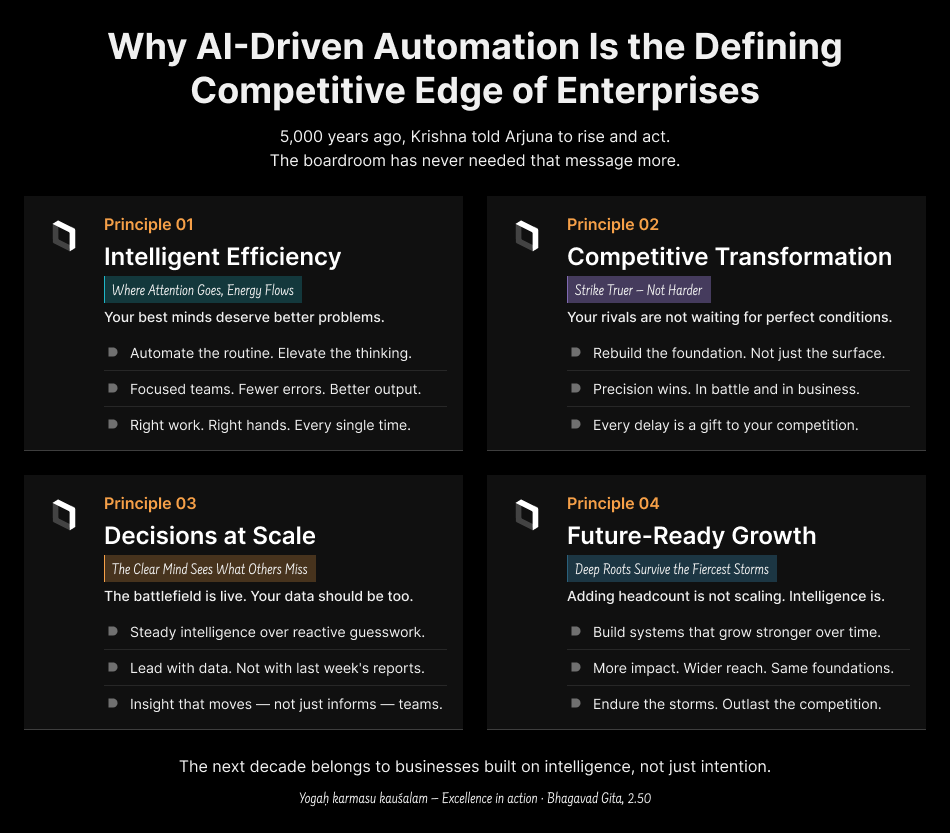
<h3>Actionable Insights</h3>Stop treating AI-driven automation as a future initiative — it is a present-day leadership decision. Audit where your best people are spending their time, identify processes that consume human effort without requiring human judgment, and build systems that give your leadership real-time visibility. The enterprises defining the next decade are making these decisions today. The question is whether you are making them too.
How AI Powers Intelligent Business Operations
There is a fundamental misunderstanding I encounter repeatedly when enterprise leaders talk about AI — they describe it as a tool that makes things faster. Speed is a byproduct, not the point. The Gita teaches us that true power is never brute force — it is the intelligent application of the right energy at the right moment. That is precisely what AI brings to business operations. It does not just accelerate what you are already doing — it changes the nature of how your business thinks, decides, and acts. At ZealousWeb, we have seen this play out across every service we offer — from performance marketing to e-commerce analytics — and the results are never incremental. They are transformational.
Leveraging Advanced Analytics For Smarter Marketing Decisions
Here is something I have noticed across almost every organisation I have worked with — they are not short on data. If anything, they are drowning in it. The real problem is that most businesses have no reliable way of turning that data into something their leadership can actually act on quickly. That is where advanced analytics comes in. It is not about collecting more — it is about finally making sense of what you already have, and building systems that surface the right insight at the right moment.
- The Prepared Mind Sees the Pattern Before Others Do
The Gita speaks of the leader who acts from deep knowledge, not surface observation. Advanced analytics does exactly that — it finds patterns in campaign data, audience behaviour, and market signals that no human analyst could detect at scale, turning raw numbers into strategic foresight. - Know the Battlefield Before You Step Onto It
For our performance marketing and SEO clients, analytics tells them where demand is heading, which audience segments are shifting, and where to place their next move before the opportunity peaks. - Data Is Not the Destination — Wisdom Is
Krishna reminded Arjuna that knowledge alone is not enough — it must translate into right action. Analytics is only as powerful as the decisions it drives. We build systems that close that gap automatically.
Automating Campaign Workflows And Performance Reporting
If there is one area where I have seen businesses experience an almost immediate difference after adopting AI, it is workflow automation. Not because it is the most glamorous part of the conversation — it is actually the most unglamorous. But that is exactly why it matters. The hours your team spends on campaign reporting, performance summaries, content tagging, and query routing are hours they are not spending on strategy. Intelligent automation quietly takes that burden off the table — and the teams that experience it never want to go back.
- Let the Arrows Fly Themselves
Krishna told Arjuna to act without attachment to the mechanics of action. Automated workflows do precisely that — executing complex, multi-step campaign processes with zero fatigue and zero variance, freeing your team for decisions that actually require judgment. - Consistency Is a Competitive Advantage
Arjuna's greatest strength was not power — it was precision under pressure. Automated reporting and campaign workflows deliver that same consistency, ensuring every process runs exactly as designed, every single time, regardless of volume. - Free the Strategist Inside Your Team
At ZealousWeb, when we automated our performance reporting workflows, our team did not shrink — it sharpened. The same people started doing higher-order work because the mechanical work was no longer on their plate.
Applying Intelligent Systems For Better Client Outcomes
Intelligent systems are the part of the AI conversation that I find most fascinating — and most misunderstood. It is not just about processing data faster. It is about contextualising it, weighing it, and arriving at decisions that actually account for nuance. When I describe it to leadership teams, I put it this way — this is where the technology stops feeling like software and starts feeling like a thinking partner. And that distinction — between a tool that executes and a system that reasons — is what separates good AI implementation from genuinely transformative client outcomes.
- The Sthitaprajna Decides From Stillness, Not Noise
The Gita's ideal decision-maker is one whose mind is undisturbed by complexity. Intelligent systems create that same quality — processing enormous amounts of client data and surfacing only what matters, so your team can act with clarity. - Context Is Everything
At ZealousWeb, when we build intelligent systems for our clients, we do not just feed them data — we build in the context that makes that data meaningful. Systems that understand the why behind the what are the ones that genuinely move client results. - From Reactive to Prescriptive
Krishna never reacted — he always prescribed the right course of action based on complete understanding. Intelligent systems move your client delivery from reactive to prescriptive — telling you not just what happened, but exactly what to do next.
Driving Efficiency, Accuracy, And Growth Across Digital Operations
Efficiency, accuracy, and growth rarely make for exciting conversation — but in my experience, they are where the real business case for AI lives. When I look at what has changed most dramatically for ZealousWeb and our clients since building AI into our operations, it is not any single dramatic result. It is the compounding effect of getting hundreds of small things consistently right, over time. That quiet consistency — running in the background, across every workflow, every campaign, and every client deliverable — is what eventually shows up in your margins, your retention, and your reputation.
- Excellence Is Not An Event — It Is A System
The Gita's definition of yoga is skill in action — not occasional brilliance, but sustained excellence. AI-driven systems deliver that sustained excellence at a scale no human team could maintain alone, across every campaign, every report, and every client touchpoint. - Accuracy At Scale Is A Strategic Asset
In performance marketing, SEO, and web development, the cost of inconsistency is not just operational — it is reputational. AI systems eliminate the variance, ensuring your client deliverables are consistently precise and on time. - Growth Is The Result Of Intelligence, Not Effort Alone
Krishna never advised Arjuna to fight harder with fewer resources. He advised him to fight with complete intelligence. True growth through AI is not about doing more — it is about doing everything smarter, so every investment compounds into measurable return.
The Invisible Engine:How AI Quietly Rewrites Business Operations
Most leaders think AI is about speed — in our experience at ZealousWeb, it’s actually about changing how a business thinks, decides, and operates with clarity.
| Capability | What We Actually Do | How It Changes Outcomes | Gita Lens |
|---|---|---|---|
 Advanced Analytics
|
We turn scattered campaign and customer data into structured insight systems that leadership can act on instantly. | Decisions shift from reactive to anticipatory — clients see opportunities before they peak. | Clarity over noise — acting from deep understanding, not surface data. |
 Workflow
Automation
Workflow
Automation
|
We automate reporting, campaign execution, tagging, and internal processes that consume operational bandwidth. | Teams move from repetitive execution to strategic thinking without increasing headcount. | Detached action — letting systems handle mechanics while humans focus on judgment. |
 Intelligent Decision Systems
|
We build systems that don’t just process data but contextualise it — recommending what to do next. | Client delivery becomes prescriptive, not reactive — improving consistency and performance. | Stillness in decision-making — clarity amidst complexity. |
 Operational Efficiency
|
We integrate AI across workflows to reduce errors, delays, and inconsistencies in delivery. | Small, consistent improvements compound into better margins, retention, and reliability. | Excellence in action — sustained precision, not occasional brilliance. |
<h3>Actionable Insights</h3>The way AI powers intelligent business operations is not through one big transformation — it is through many small, consistent improvements that compound over time. Start by identifying where your marketing and delivery workflows are leaking time and energy. Automate the reporting. Build analytics that tell you what is coming, not just what happened. And invest in systems that give your team the context they need to make better decisions faster. That is where the real operational edge lives.
What AI-Powered Business Process Automation Looks Like in Practice
Most conversations about AI stay at the level of possibility. What I find far more useful — and what I think every enterprise leader actually needs — is a ground-level view of what looks like when it is actually running inside a business. The Gita does not just teach philosophy — it shows Arjuna exactly what right action looks like in the middle of a real battlefield. That is the same shift I want to make here. Not what AI could do in theory, but what it actually does in practice, inside organisations that have made the decision to build with intelligence.
How AI Is Transforming Client Onboarding And Communication
Client onboarding is one of those processes that every business knows is important and almost every business handles inconsistently. At ZealousWeb, when we started building intelligence into our onboarding workflows, the first thing we noticed was not speed — it was consistency. Every client received the same quality of communication, the same clarity of process, and the same attention to detail, regardless of which team member was handling the account.
- The Disciplined Warrior Prepares Before The Battle Begins
The Gita teaches that preparation is not separate from action — it is the foundation of it. AI-driven onboarding systems ensure every client relationship begins with the same standard of precision, communication, and clarity that sets the tone for everything that follows. - Every Client Deserves Your Best — Not Your Available
Without intelligent systems, client experience depends entirely on who is available and how much bandwidth they have that day. AI removes that variability — ensuring your best process runs every time, for every client, at every stage. - Communication That Thinks Ahead
Intelligent communication systems do not just respond — they anticipate. From automated follow-ups to personalised status updates, AI keeps clients informed and confident without your team having to manually manage every touchpoint.
What Automated Performance Marketing Looks Like Day To Day
Performance marketing without automation is like fighting a battle by sending messengers on horseback. By the time the information arrives, the moment has passed. At ZealousWeb, our performance marketing operations run on a foundation of automated monitoring, real-time reporting, and intelligent optimisation — and the difference it makes to our clients is not subtle. Campaigns that used to require daily manual intervention now self-adjust based on live performance data, freeing our strategists to focus on the decisions that actually require human judgment.
- React To The Battlefield As It Changes, Not As It Was
Krishna never fought yesterday's war. Automated performance marketing systems monitor campaigns in real time, adjusting bids, reallocating budgets, and flagging anomalies the moment they appear — not the morning after. - The Strategist Should Strategise, Not Compile
When your marketing team is not buried in pulling reports, they are building better campaigns. Automation handles the mechanical so your people can do the meaningful — which is exactly what the Gita calls right action in right proportion. - Consistency Across Every Campaign, Every Day
Performance marketing at scale demands a level of consistency no manual team can sustain. Intelligent automation ensures every campaign runs to its full potential, every single day, without the variance that comes with human fatigue.
How E-Commerce Brands Are Using AI To Personalise At Scale
Personalisation is one of those words that gets used so freely in marketing that it has almost lost its meaning. But what I have seen AI do for e-commerce brands is restore that meaning entirely. True personalisation — where every customer receives an experience that feels built for them — is only possible at scale when intelligent systems are running underneath it. Our e-commerce analytics work at ZealousWeb is built on exactly this premise: that every data point a customer generates is an opportunity to serve them better.
- Know Your Customer The Way Arjuna Knew His Bow
Arjuna's mastery came from complete familiarity with his instrument. AI-powered personalisation gives e-commerce brands that same depth of knowledge about their customers — their behaviour, their preferences, their timing — and uses it to deliver experiences that feel genuinely personal. - Scale Without Losing The Human Touch
The Gita teaches us that the greatest leaders serve every individual with complete attention. AI makes that possible at scale — delivering personalised product recommendations, dynamic pricing, and tailored communication to thousands of customers simultaneously. - Turn Data Into Loyalty
Every interaction a customer has with your e-commerce platform is a signal. Intelligent systems read those signals in real time and respond in ways that deepen the relationship — turning one-time buyers into repeat customers and repeat customers into advocates.
What AI-Driven Web Development And Delivery Actually Looks Like
Web development is an area where the gap between teams that have embraced AI-driven processes and those that have not is becoming very visible, very quickly. At ZealousWeb, AI has changed how we plan, build, test, and deliver across our front-end, back-end, and e-commerce development work. It has not replaced our developers — it has made them significantly more capable, more consistent, and more focused on the work that actually requires creative and technical judgment.
- Build Once. Scale Infinitely. Improve Continuously.
The Gita speaks of systems that are self-sustaining and self-improving. AI-assisted development creates exactly that — codebases that are cleaner, delivery pipelines that are faster, and quality assurance processes that catch errors before they reach the client. - The Best Developer Is A Well-Supported One
Krishna did not ask Arjuna to fight alone — he gave him everything he needed to perform at his highest level. AI tools in development do the same — handling repetitive coding tasks, automating testing, and surfacing potential issues early so your developers can focus on architecture and innovation. - Delivery That Matches The Promise
In web development, the gap between what was promised and what was delivered is where trust is lost. AI-driven project management and quality assurance systems close that gap — ensuring timelines are met, standards are maintained, and clients receive exactly what was agreed.
You may also find this useful if you're exploring how AI and automation apply in more practical, resource-conscious environments, especially for smaller or distributed teams:
AI and Automation: Affordable Solutions for SMBs to Manage Remote Teams Efficiently
<h3>Actionable Insights</h3>AI-powered automation is not an abstract concept — it is already running inside the businesses you compete with. The practical starting point is simpler than most leaders think: pick one area where inconsistency is costing you — client onboarding, campaign reporting, e-commerce personalisation, or delivery quality — and build an intelligent system around it. Do not try to automate everything at once. Start with one process, prove the value, and let the compounding effect do the rest.
Challenges In Implementing AI For Business Process Automation
I want to be honest about something that does not get said enough in conversations about AI — implementation is hard. Not impossible, not even particularly mysterious, but genuinely hard. The Gita never promised Arjuna that the right path would be easy — it promised that the right path would be worth it. That is exactly how I think about the challenges of implementing AI-driven automation. Every obstacle I have encountered — and I have encountered all of them — has ultimately made the systems we built stronger, the teams we built them with wiser, and the outcomes we delivered more durable. The key is knowing what you are walking into before you walk into it.
Integrating Seamlessly With Legacy Systems
This is the challenge I hear about most consistently from leadership teams — and it is the one that causes the most hesitation. Most enterprises are not starting from a clean slate. They have systems, platforms, and processes that have been built up over years, sometimes decades, and the idea of introducing AI into that environment feels overwhelming. I understand that feeling. But in my experience, the problem is never the legacy system itself — it is the assumption that everything needs to change at once.
- Do Not Tear Down The Fort To Build A Better One
The Gita teaches us that wisdom lies in working with what exists, not against it. The most successful AI integrations I have seen are the ones that started by understanding the existing architecture deeply before touching a single process. - Build Bridges, Not Barriers
At ZealousWeb, when we work with clients who have existing platforms and workflows, our first instinct is never to replace — it is to connect. Intelligent middleware and API-driven integrations allow new AI capabilities to sit alongside legacy systems without disrupting what is already working. - Start Small, Prove Fast, Scale Smart
Arjuna did not win the war in a single day. The most effective approach to legacy integration is incremental — identify one high-value process, integrate intelligently, prove the value, and build confidence before expanding.
Managing Data Privacy And Security Complexities
Data privacy and security is the challenge that keeps most enterprise leaders up at night — and rightly so. AI systems are only as trustworthy as the data practices that underpin them. At ZealousWeb, this is a conversation we take seriously at every level of our work — from how we handle client data in our analytics systems to how we build data governance into every digital solution we deliver.
- Guard What Is Sacred
The Gita teaches that a true leader protects what has been entrusted to them with the same conviction they bring to every other decision. Client data is sacred — and the AI systems you build must treat it that way, with robust governance, clear access controls, and absolute transparency. - Compliance Is Not A Constraint — It Is A Foundation
Krishna never saw dharma as a limitation — he saw it as the very structure that made right action possible. Data compliance frameworks are not obstacles to AI implementation — they are the foundation on which trustworthy AI is built. - Transparency Builds Trust
The organisations I have seen navigate data privacy most successfully are the ones that treat it not as a legal requirement but as a client promise. When your clients know exactly how their data is being used, trust deepens — and that trust becomes a genuine competitive advantage.
Navigating Organizational Change And Workforce Adaptation
Of all the challenges in AI implementation, this is the most human — and therefore the most complex. Technology is the easy part. People are harder. I have sat in rooms where the announcement of an AI initiative has been met with genuine fear — fear of redundancy, fear of irrelevance, fear of a future that does not have a place for the skills people have spent years developing. That fear is real and it deserves a real response.
- The Leader's Duty Is To Prepare, Not Just To Announce
Krishna did not hand Arjuna a new weapon and walk away. He prepared him — mentally, philosophically, strategically — for everything that was coming. Leaders implementing AI have the same responsibility. Preparation and communication are not optional — they are the work. - Change That Is Explained Is Change That Is Accepted
The Gita teaches that clarity dissolves fear. When your team understands not just what is changing but why, and what their role looks like on the other side of that change, resistance transforms into participation. - Upskilling Is Not A Kindness — It Is A Strategy
At ZealousWeb, every time we have introduced new intelligent systems into our workflows, we have invested equally in bringing our people with us. The teams that thrive in an AI-augmented environment are the ones whose leaders treated upskilling as seriously as the technology itself.
Balancing Automation With Human Oversight
This is perhaps the most nuanced challenge of all — and the one I think about most carefully in everything we build at ZealousWeb. Automation without oversight is not efficiency — it is risk. The goal of AI-driven business process automation is never to remove human judgment from the equation. It is to remove human effort from the parts of the equation that do not require judgment, so that human intelligence can be applied where it matters most.
- The Charioteer And The Warrior Must Work As One
Krishna was Arjuna's charioteer — guiding, advising, and steering — but Arjuna held the bow. That relationship between AI and human is the model every enterprise should build toward. AI steers and informs. Humans decide and are accountable. - Automate The Repeatable. Protect The Irreplaceable.
The clearest framework I use when thinking about automation and oversight is this: if a task is repeatable, rules-based, and data-driven, automate it. If it requires empathy, ethical judgment, or creative thinking, protect it. Keep humans exactly where they are irreplaceable. - Oversight Is Not Inefficiency — It Is Intelligence
The Gita never glorified blind action — it always paired action with awareness. The strongest AI systems are the ones built with human oversight baked in — not as an afterthought, but as a deliberate design principle that ensures accountability at every level.
<h3>Actionable Insights</h3>The challenges of implementing AI for business process automation are real — but none of them are insurmountable. The leaders who navigate them successfully share one common trait: they treat implementation as a change management exercise as much as a technology exercise. Start with your legacy systems by mapping before you build. Establish your data governance framework before you scale. Bring your people into the conversation before you roll out the change. And never let automation run without a human accountability structure sitting above it. These are not constraints on your AI ambitions — they are the conditions that make those ambitions sustainable.
Impact Of AI-Driven Automation On Workforce And Culture
What I have seen in practice is that AI-driven automation doesn’t really disrupt teams — it exposes how they actually function. At ZealousWeb, when we started embedding intelligence into workflows, it became very clear, very quickly, who was operating on clarity and who was relying on process dependency. Because once systems take over execution, what remains is thinking — and that’s where the real shift happens.
And this isn’t a one-time adjustment. Every time the system evolves, the team has to evolve with it. What worked six months ago stops working the same way. So the focus, at least for us, has been very deliberate — not just on implementing AI, but on shaping how our people grow alongside it.
Redefining Roles And Future Skill Requirements
The most visible shift I have seen is not roles disappearing, but expectations changing underneath them. The same titles start demanding very different thinking. At ZealousWeb, people who were earlier focused on execution are now expected to bring interpretation and direction. Once systems take over repetitive work, value naturally shifts upward — towards judgment, clarity, and decision-making. That’s where the real adjustment happens.
- From Execution To Interpretation — Karma Is Defined By Intent, Not Motion
The Gita reminds us that action is not about movement alone, but the consciousness behind it. In the same way, roles today are less about doing more and more about understanding what the system is actually telling you. - Judgment As The Core Skill — Buddhi Over Routine
Krishna emphasises buddhi — the ability to discern. With systems handling data and repetition, what matters now is how clearly someone can interpret and decide. - Adaptability Over Specialisation — Detachment Enables Growth
The Gita speaks about not being attached to a fixed identity. Teams that aren’t rigid about “this is what I do” are the ones that adapt faster as tools and systems evolve. - Ownership Of Outcomes — Responsibility Cannot Be Delegated To Systems
“Karmanye vadhikaraste…” isn’t about passive effort — it’s about responsible action. With automation, individuals are expected to own results, not just the tasks they perform.
Fostering Collaboration Between Humans And AI
One shift that made a real difference for us was changing how we positioned AI internally. Not as a tool people use, but as something they actively work with. That shift in mindset changed behaviour completely. People stopped either over-trusting or resisting it — and started engaging with it more thoughtfully. The best outcomes, in my experience, always come from that balance.
- The Charioteer And The Warrior — Guidance And Action Must Work Together
Krishna guided Arjuna, but didn’t fight for him. AI plays a similar role — it supports direction, but execution and accountability still sit with people. - Augmentation Over Replacement — Balance Defines Right Action
The Gita consistently avoids extremes. The goal is not full automation, but the right balance between system efficiency and human judgment. - Engage, Do Not Surrender — Awareness Must Accompany Action
Blind acceptance is never encouraged. Teams need to question outputs, refine inputs, and actively improve how systems behave. - Shared Accountability — Dharma Cannot Be Outsourced
Responsibility doesn’t shift to the system. Even with AI in place, ownership of decisions and outcomes stays with the individual.
Building A Culture Of Continuous Learning And Innovation
What I have learned the hard way is that learning cannot be treated as a separate phase. The moment you introduce AI, learning becomes part of daily work. At ZealousWeb, every system we implement changes how work happens — which means teams have to keep adjusting in real time. There’s no “we’ve learned this” moment anymore — it’s continuous.
- Learning As A Continuous State — Growth Is Ongoing, Not Event-Based
The Gita’s idea of awareness is constant. In the same way, teams need to keep learning as systems evolve — not just at the start. - Curiosity As Strength — Questions Drive Clarity
Arjuna’s journey begins with questioning. The more teams explore and challenge systems, the more value they extract from them. - Shared Growth — Knowledge Should Not Stay Isolated
The Gita is a dialogue. Similarly, insights need to be shared across teams so that learning becomes collective, not individual. - Raising The Standard — Excellence Keeps Evolving
“Yoga is skill in action” implies continuous refinement. As systems improve, expectations and benchmarks must evolve too.
Empowering Teams To Thrive In A Hybrid Workplace
Hybrid environments add complexity that traditional workflows struggle to handle. What AI has helped us do at ZealousWeb is reduce that dependency on constant coordination. But more than the tools, it’s about how clearly workflows are designed. Because in a distributed setup, clarity replaces proximity.
- Stability In Changing Environments — Performance Should Not Depend On Location
The Gita speaks about steadiness regardless of surroundings. Systems should ensure work continues smoothly, no matter where teams are. - Clarity Reduces Dependence — Awareness Removes Friction
When systems provide clear direction, teams don’t need constant follow-ups. They can act independently with confidence. - Autonomy With Discipline — Freedom Needs Structure
The Gita balances freedom with discipline. Hybrid teams perform best when autonomy is supported by clear systems and accountability. - Consistency Across Distance — Standards Must Remain Uniform
Whether teams are remote or together, execution quality should not vary. AI helps maintain that consistency across environments.
<h3>Actionable Insights</h3>If there’s one thing I’ve learned, it’s this — you can’t treat workforce impact as a side effect of AI. It has to be designed intentionally. Define roles around decision-making, not tasks. Be clear about where systems stop and human judgment begins. Build learning into daily work, not separate from it. And most importantly, create workflows that bring clarity — especially in hybrid setups. That’s what allows teams to actually grow with the systems, not struggle against them.
Measuring The Effectiveness Of AI In Business Process Automation
One mistake I see quite often is that teams implement AI and then assume improvement is obvious. In reality, it rarely is — unless you define what “better” actually means. At ZealousWeb, we learned this early. Without clear measurement, automation starts feeling productive without necessarily being effective. And that gap is dangerous, because it creates a false sense of progress.
For us, measuring AI has never been about just numbers — it’s about clarity. Are we making better decisions? Are we reducing unnecessary effort? Are outcomes actually improving? The Gita places a strong emphasis on awareness in action — not just doing, but understanding the impact of what is being done. That mindset is critical here.
Establishing Clear KPIs For Automation Success
The first shift we had to make was defining success properly. Not broad goals, but very specific indicators tied to outcomes. Because if KPIs are vague, automation ends up optimising the wrong things. At ZealousWeb, we focus on metrics that actually reflect improvement — not just activity.
- Define What Matters — Clarity Before Action
The Gita emphasises clarity of purpose. KPIs should be tied to outcomes that genuinely matter, not surface-level activity. - Outcome Over Output — Results Define Value
It’s easy to measure volume, but what matters is impact. Systems should be evaluated on the quality of results they produce. - Consistency As A Metric — Stability Reflects Control
Right action is consistent action. Measuring variance and stability often reveals more than measuring averages. - Alignment Across Teams — Shared Understanding Matters
When everyone works with the same definition of success, execution becomes far more effective.
Tracking ROI And Operational Improvements
ROI in AI is often misunderstood. It’s not always immediate, and it’s not always financial in the beginning. At ZealousWeb, we look at ROI as a combination of efficiency, time saved, and decision quality. The returns compound over time — but only if you’re tracking them consciously.
- Measure What Changes — Awareness Drives Insight
The Gita teaches observation without assumption. Track what is actually improving, not what you expect to improve. - Time As A Return — Efficiency Is Real Value
Saving time across workflows is one of the earliest and most tangible returns of automation. - Cost Vs Value — Not All Gains Are Immediate
Some improvements don’t reflect instantly in revenue, but they strengthen long-term capability. - Compounding Impact — Small Gains Build Over Time
Just like disciplined action in the Gita, consistent small improvements create significant long-term results.
Leveraging Analytics To Optimize AI Workflows
Once systems are in place, the real work begins. Optimization is not a one-time effort — it’s continuous. At ZealousWeb, analytics plays a central role in this. It helps us understand where systems are performing well and where they need refinement. Without this layer, automation becomes static.
- Observe Patterns — Insight Comes From Attention
The Gita values awareness. Analytics helps identify patterns that are not immediately visible. - Refine Continuously — Improvement Never Stops
Systems need constant tuning. Small adjustments over time lead to significant efficiency gains. - Close The Loop — Feedback Strengthens Systems
Every output should inform the next iteration. Feedback loops are critical for long-term accuracy. - Act On Data — Knowledge Must Lead To Action
Insight without action has no value. Analytics should directly influence decisions and improvements.
Evaluating Long-Term Business Impact And Scalability
Short-term wins are easy to measure. Long-term impact is where most organisations struggle. At ZealousWeb, we look beyond immediate gains and focus on whether systems can scale, adapt, and continue delivering value as the business grows. Because that’s where AI actually proves itself.
- Think Long-Term — Perspective Shapes Decisions
The Gita consistently emphasises long-term thinking over short-term reactions. The same applies to AI investments. - Scalability Matters — Systems Should Grow With You
What works at a small scale should continue to work as complexity increases. - Resilience Over Speed — Stability Sustains Growth
Fast systems are useful, but stable systems are dependable over time. - Sustained Value — True Impact Is Continuous
The real measure of AI is not immediate success, but whether it keeps delivering value consistently.
<h3>Actionable Insights</h3>If you’re implementing AI, don’t leave measurement as an afterthought. Define KPIs early, and make sure they reflect real outcomes. Track ROI beyond just revenue — include time, efficiency, and decision quality. Use analytics actively to refine systems, not just report on them. And most importantly, evaluate impact over the long term. Because AI doesn’t prove its value in moments — it proves it over time.
Ethical Considerations And Risks In AI Automation
One thing I’ve learned working closely with AI systems is this — the more powerful the system, the less visible its mistakes become. And that’s where the real risk lies. At ZealousWeb, we’ve seen that automation doesn’t just scale efficiency, it also scales decisions. Which means if something is off — logic, data, or intent — it doesn’t stay small. It multiplies.
That’s why ethics in AI is not a separate conversation for us — it’s built into how we design and deploy systems. The Gita repeatedly brings us back to dharma — right action with awareness and responsibility. And in an AI-driven environment, that becomes very real. Because when decisions are no longer fully human, accountability has to be even more intentional.
Ensuring Transparency And Accountability In AI Decisions
One of the first things we realised is that if a system cannot explain its decision, it becomes very difficult to trust it. At ZealousWeb, we focus on making sure that AI-driven outcomes are not just accurate, but also understandable. Because without transparency, even the right decision creates doubt.
- Clarity In Decisions — Visibility Builds Trust
The Gita emphasises awareness in action. Systems should not operate like black boxes — teams need to understand how and why decisions are made. - Defined Ownership — Responsibility Must Be Clear
No matter how advanced the system is, accountability cannot shift away from people. Ownership of outcomes must always be defined. - Explainable Outputs — Logic Should Be Traceable
Decisions should be backed by reasoning that teams can interpret, validate, and question when needed. - Controlled Autonomy — Freedom Needs Boundaries
Just like in the Gita, where action is guided by discipline, AI systems should operate within clearly defined limits.
Addressing Bias And Algorithmic Fairness
Bias in AI is rarely obvious — it often comes from the data or assumptions behind the system. We’ve encountered situations where outputs looked correct on the surface but carried subtle bias underneath. That’s why fairness is something we actively evaluate, not assume.
- Awareness Of Bias — What You Don’t See Still Exists
The Gita teaches self-awareness. In AI, that translates to recognising that bias can exist even when it’s not immediately visible. - Data Responsibility — Input Shapes Output
Systems learn from data. If the data carries bias, the decisions will too — which makes data quality critical. - Continuous Review — Fairness Needs Monitoring
Bias is not a one-time fix. Systems need to be reviewed and adjusted regularly to maintain fairness. - Balanced Judgment — Objectivity Over Assumption
Just like buddhi in the Gita, decisions should be guided by clarity, not unchecked patterns.
Upholding Compliance With Global Regulatory Standards
As AI systems become more embedded into business processes, compliance is no longer optional — it’s foundational. At ZealousWeb, we’ve had to align systems not just with internal standards, but with external regulations across different regions. And that adds another layer of responsibility.
- Respect Boundaries — Rules Define Right Action
The Gita does not separate freedom from responsibility. Similarly, AI systems must operate within defined legal and ethical frameworks. - Data Protection — Privacy Is Non-Negotiable
Handling data responsibly is critical. Systems must ensure that user information is protected at every level. - Adapt To Change — Regulations Will Evolve
Just like systems evolve, so do regulations. Staying compliant requires continuous adjustment. - Documentation Matters — Accountability Needs Evidence
Clear records of how systems function and make decisions are essential for both compliance and trust.
Building Trust Through Responsible AI Practices
At the end of the day, everything comes down to trust. If teams or clients don’t trust the system, they won’t rely on it — no matter how efficient it is. At ZealousWeb, we’ve seen that trust is not built through claims, but through consistent, responsible behaviour over time.
- Consistency In Action — Trust Builds Over Time
The Gita emphasises steady, disciplined action. Trust in AI grows when systems perform reliably over time. - Human Oversight — Judgment Cannot Be Removed
No matter how advanced automation becomes, human judgment remains essential in critical decisions. - Ethical Design — Intent Shapes Outcome
Systems reflect the intent behind them. Responsible design ensures better, more reliable outcomes. - Transparency In Practice — Openness Strengthens Confidence
Being clear about how systems work builds confidence — both internally and externally.
<h3>Actionable Insights</h3>Ethics in AI cannot be treated as a checklist — it has to be built into the system from the start. Focus on transparency so decisions can be understood. Actively monitor and correct bias. Stay aligned with evolving regulations. And most importantly, design systems in a way that builds trust over time. Because in the end, the success of AI is not just measured by efficiency — but by how responsibly it operates.
Future Trends: Where AI and Business Process Automation Are Going
If there’s one thing I’ve learned working with AI over the years, it’s this — the technology never really stabilises. Just when you think you’ve optimised a system, something shifts. A better model, faster processing, smarter integrations. At ZealousWeb, we’ve had to accept that AI is not something you “finish implementing” — it’s something you keep evolving with.
And honestly, the future is not about completely new directions — it’s about deeper integration. Systems becoming more connected, decisions becoming more predictive, and automation becoming more embedded into everyday operations. The Gita talks about seeing the larger picture while acting in the present — and that’s exactly how we’ve started looking at AI. Not just as a tool for today, but as something that shapes how we build for tomorrow.
Accelerating Adoption Of Intelligent Automation
What we’re seeing now is a clear shift — AI is no longer experimental. It’s moving into core business functions much faster than before. At ZealousWeb, conversations have moved from “should we use AI?” to “how deeply can we integrate it?” That shift changes everything.
- From Optional To Essential — Adoption Is No Longer A Choice
The Gita speaks about acting in alignment with the time. AI is quickly becoming a baseline capability, not a differentiator. - Speed Of Implementation — Time Defines Advantage
The ability to implement and adapt quickly is becoming more valuable than the technology itself. - Wider Accessibility — Capability Is Spreading Fast
Tools are becoming easier to use, which means more teams can adopt AI without deep technical barriers. - Execution Focus — Value Comes From Application
Just like in the Gita, knowledge alone is not enough — impact comes from how effectively it is applied.
Integrating AI With IoT And Edge Computing
One trend that’s becoming very real for us is how AI is starting to connect with real-world data through devices and edge systems. This is where automation moves beyond workflows and into environments. Decisions are no longer delayed — they happen closer to where data is generated.
- Real-Time Decisions — Action Happens Instantly
The Gita emphasises timely action. With edge computing, decisions can be made in the moment, not after the fact. - Connected Systems — Everything Starts Talking
Devices, platforms, and workflows begin to operate as one connected system rather than isolated parts. - Reduced Latency — Speed Improves Accuracy
Faster processing leads to more relevant and timely decisions. - Context Awareness: Decisions Become Smarter
Systems start factoring in real-world conditions, not just historical data.
Advancing Predictive And Prescriptive Analytics
We’ve already moved past descriptive analytics. What we’re seeing now is systems that not only predict outcomes but also suggest the next best action. At ZealousWeb, this is where AI starts becoming truly valuable — when it moves from insight to direction.
- Predict Before It Happens — Foresight Drives Action
The Gita encourages awareness beyond the present moment. Predictive systems help anticipate outcomes before they unfold. - Recommend Next Steps — Guidance Improves Decisions
Prescriptive analytics goes a step further — not just showing what might happen, but suggesting what to do about it. - Reduce Uncertainty — Clarity Replaces Guesswork
Better insights reduce reliance on assumptions and improve decision confidence. - Continuous Learning — Systems Keep Improving
The more data systems process, the better they get at predicting and guiding outcomes.
Shaping The Future Of Connected Digital Enterprises
What all of this is leading to is a much more connected way of operating. At ZealousWeb, we’re already seeing early signs of this — where different functions, systems, and teams are no longer working in silos, but as part of a unified structure driven by shared intelligence.
- Unified Ecosystems — Silos Start Disappearing
The Gita speaks of interconnectedness. Similarly, systems begin to function as part of a larger whole. - Seamless Workflows — Friction Gets Eliminated
Integration reduces gaps between processes, making execution smoother and faster. - Scalable Intelligence — Systems Grow With Business
As organisations expand, intelligence scales alongside operations. - Adaptive Enterprises — Change Becomes Easier
Connected systems make it easier to respond to new challenges and opportunities.
<h3>Actionable Insights</h3>The future of AI in business process automation is not about chasing trends — it’s about preparing for deeper integration. Focus on building systems that can evolve, not just perform. Start connecting workflows instead of optimising them in isolation. Invest in capabilities that improve decision-making, not just execution. And most importantly, stay adaptable. Because with AI, the real advantage doesn’t come from what you build once — it comes from how well you keep evolving it.
Conclusion: Embracing AI as a Catalyst for Purposeful Growth
When I look at how we’ve implemented AI at ZealousWeb, it’s clear that the real impact hasn’t come from automation alone, but from how it has refined the way we operate. Processes have become faster, but more importantly, decisions have become clearer and more consistent. That’s exactly how we approach our clients as well — not by pushing AI as a solution, but by strategically guiding where it actually creates value in their business. Because growth doesn’t come from adding more technology, it comes from applying it with clarity.
What has worked for us — and what we bring to our clients — is keeping the approach practical and scalable. We don’t try to automate everything at once. We identify the right entry points, build strong foundations, and then expand with intent. The Gita’s emphasis on disciplined action reflects strongly here — sustainable outcomes come from doing the right things in the right sequence, not from rushing into complexity. And at the same time, every system we design is built to evolve, so our clients are not just solving for today, but preparing for what comes next.
Ultimately, AI is not something that sits outside the business — it becomes part of how the business thinks and operates. Our role in that journey is not just implementation, but direction. Helping clients make better decisions about where to apply AI, how to scale it, and how to make it sustainable over time. Because when done right, AI doesn’t feel like a disruption — it becomes a quiet, consistent advantage that strengthens the business at every level.
FAQs
How can businesses use AI in process automation without overhauling their existing systems?

Businesses can start by integrating AI into specific workflows—such as customer support or data processing—without replacing their entire tech stack. Many modern AI tools are designed to work alongside existing systems, enabling gradual adoption and faster ROI.
What advantages does AI-driven automation offer to agencies managing multiple client projects?
For agencies, AI automation helps streamline repetitive tasks like reporting, data analysis, and campaign optimization. This allows teams to handle more clients efficiently, reduce turnaround time, and deliver consistent, high-quality results at scale.
Is AI automation more cost-effective for businesses or agencies in the long run?
Both benefit, but in different ways. Businesses typically see cost savings through operational efficiency, while agencies gain profitability by increasing delivery capacity without proportionally expanding their teams.
How can agencies use AI to overcome skill gaps in ongoing projects?
Agencies can leverage AI tools to supplement expertise in areas like data analysis, content generation, and customer insights. This reduces dependency on hiring niche specialists and helps maintain project momentum without delays.
What should businesses consider before implementing AI in their processes?
Businesses should evaluate their data readiness, identify high-impact automation opportunities, and ensure proper change management. Starting with clearly defined use cases helps minimize risk and ensures smoother adoption.
