

.webp)




Table of Contents
Introduction
I've spent years working at the intersection of technology and people strategy — and one question keeps finding me no matter what we're building at ZealousWeb: What does it actually mean to lead well when the machines are getting smarter? Today, our teams work with AI tools and automation that would have seemed extraordinary even five years ago. Claude AI drafts campaign briefs and content strategies in minutes. Perplexity conducts research that once took analysts days. NotebookLM synthesizes entire knowledge bases to sharpen how we think about a client's market. Midjourney generates visual concepts for branding and digital campaigns before a designer has opened a single file.
Whether we're helping a client scale their e-commerce presence, deploying a performance marketing strategy, or augmenting a development team with the right React or Laravel talent — the tools have never been more capable, and the promise is real: faster value creation, more output, leaner execution. And yet, the more powerful our systems become, the louder a different kind of question gets: are we becoming less human in the process?
That question sits at the heart of everything I believe about leadership today. Because tools don't retain talent, build trust, or make people feel that their work matters — leaders do. Gallup's State of the Global Workplace: 2026 Report found that global employee engagement has fallen to 20%, its lowest level since 2020, costing the world economy an estimated $10 trillion in lost productivity — roughly 9% of global GDP. Gallup describes the most disengaged workers not merely as unhappy, but as employees who are "resentful that their needs are not being met and are acting out their unhappiness." In a services business where the quality of thinking is the product, that's not an HR footnote. It's a structural risk. And it's exactly why I believe that in a tech-driven world, purpose isn't the soft side of leadership. It's the strategy.
Why Purpose-Driven Leadership Matters
As AI evolves from being a tool to becoming a collaborator—and now, with the rise of Agentic AI systems that can act, decide, and optimize with minimal intervention—the role of leadership is undergoing a fundamental shift. At ZealousWeb, this shift is not abstract. It shows up in how we interpret data, how we run campaigns, how we build platforms, and most importantly, how our people relate to the work they do.Because when machines can execute, optimize, and even recommend actions, leadership has to anchor something deeper: purpose.
Breaking Traditional Success Models
There was a time when success in our world was clearly defined by output.
- In SEO, it meant rankings and traffic.
- In performance marketing, it meant ROAS and conversions.
- In web development, it meant delivering functional, scalable platforms on time.
And we built strong capabilities around that.
But as AI-driven marketing tools and Generative AI began accelerating execution—writing content, generating ad variations, designing layouts—the gap between output and impact became more visible. I remember reviewing an e-commerce analytics dashboard for a client. On paper, everything looked strong—traffic was up, campaigns were performing, conversions were stable. But something felt off.
When we went deeper into web analytics and user behavior, we realized customers weren’t engaging with the brand the way we expected. They were transacting, but not connecting. That’s when it became clear: we were optimizing performance, but not necessarily building meaning.
Today, with Agentic AI capable of autonomously optimizing campaigns and suggesting next-best actions, execution is no longer the constraint. The real question is whether we’re solving the right problems. I’ve seen this most clearly in branding and digital experience work. When teams move beyond metrics and understand the intent behind the business, the output changes—from functional delivery to meaningful experience.
And that shift is what separates activity from impact. A 2025 study by PwC and the Association of National Advertisers — drawing on five years of data across 190+ companies — found that brands excelling at marketing outpaced the S&P 500 by 8.8 percentage points annually and delivered 79% higher shareholder returns than their peers. That kind of outcome doesn't come from doing more. It comes from doing what matters.
Demand For Meaningful Leadership
McKinsey researchers captured something important when they wrote: "Employees expect their jobs to bring significant purpose to their lives. Employers need to help meet this need or be prepared to lose talent to companies that will."
I've seen this play out at ZealousWeb. The teams that stay committed through tight deadlines and evolving client expectations aren't driven just by delivery targets—they stay because they believe in the impact of the work. The moments where engagement drops are rarely about workload; they happen when the connection to purpose starts fading.
Nearly 70% of employees say they prefer working for organizations with a strong purpose, and 90% report feeling more motivated in such environments. These aren't marginal numbers. These are the people sitting in your all-hands right now, deciding whether to bring their best ideas to work tomorrow.
Advantage Of Purpose-Led Growth
The growth numbers speak plainly. Research from McKinsey found that companies combining creativity, analytics, and purpose — what they call the "growth triple play" — grow 2.3 times faster than those investing in none of the three. Monitor Deloitte's 2021 market analysis reinforces this, identifying a "purpose premium" — evidence that purpose-driven companies consistently outperform their peers across brand, innovation, talent, and risk management.
And this is where the skeptics usually pause. Because 2.3x faster growth sounds like a marketing claim. But when you break down the mechanics — higher employee retention, stronger customer loyalty, better innovation velocity — the compounding logic holds. Purpose reduces friction at every layer of the business.
Shaping Organizational Culture And Long-Term Sustainability
Culture is the thing that determines whether your strategy actually gets executed. I've worked in environments where the strategy was excellent and the culture undermined it at every turn. And I've seen the opposite — organizations with imperfect strategies that somehow kept winning because the culture made people resourceful, resilient, and committed.
Deloitte Global's 2025 Gen Z and Millennial Survey — covering nearly 23,500 respondents across 44 countries — found that 44% of Gen Zs and 45% of millennials have already left a role they felt lacked purpose. These aren't people planning to leave. They already did. When nearly half your future workforce has walked away from a job because it didn't mean anything to them, that's not a retention problem — it's a culture problem. And culture problems don't show up in quarterly reports until it's too late.
Both of those numbers compound over time. Retention means institutional knowledge stays. A culture built on purpose means the next product cycle is stronger. Purpose isn't separate from sustainability — it is the sustainability strategy.
<h3>Actionable Insights</h3>Leaders must move beyond optimizing for output and start defining what truly matters. Align AI, metrics, and decision-making with a clear sense of purpose—not just performance. Ensure every team understands the “why” behind their work, not just the “what.” In a world where execution is automated, meaning becomes the real differentiator.
How To Shift From Profit To Purpose In Tech
Shifting from profit to purpose isn’t about replacing financial goals—it’s about redefining what success truly means. As AI takes over execution, leaders must focus on intent, impact, and the meaning behind decisions. This shift requires rethinking metrics, embedding human judgment, and aligning strategy with real-world value. Because in a tech-driven world, purpose is what ensures that progress remains relevant and responsible.
Redefine Business Metrics To Include Purpose
Shifting from profit to purpose doesn't mean abandoning financial discipline. It means expanding what you measure. If your only north star is quarterly revenue, you will optimize for quarterly revenue—and miss everything else.
At ZealousWeb, I started asking different questions alongside the commercial ones: What percentage of our developers and designers feel their work has a meaningful impact on the clients they serve? What is our net promoter score among people who left the company, not just among clients? How many internal promotions did we make versus external hires? These aren't vanity metrics. They are leading indicators of organizational health — and in a services business built on human expertise, they are also predictors of delivery quality.
When you add purpose-adjacent metrics to your leadership scorecard, you start making different decisions. You weigh hiring choices differently. You think harder about which client relationships to pursue. The data you collect begins to tell a richer story about whether you're building something that lasts.
Embed Human-Centered Principles In Decision-Making
One of the most practical shifts I've made is treating human impact as a first-order consideration in decision-making, not a downstream check. Before a policy changes, before a restructure is announced, before a technology is deployed — asking: How does this land with the people it affects?
This sounds simple. It is harder than it sounds, because it slows you down at first. But it prevents the kind of trust erosion that takes years to rebuild. Gallup found that only 23% of U.S. employees strongly agree that they trust the leadership of their organization — a number that, despite years of attention on workplace culture, has barely moved. That should alarm every leader. Trust is the substrate on which everything else is built, and once it's gone, no amount of all-hands transparency or company swag brings it back quickly.
Embedding human-centered principles means making empathy a design constraint, not an afterthought.
Align Product And Service Strategies With Societal Impact
The most durable tech companies I've studied are the ones whose products solve real human problems — not manufactured ones. At ZealousWeb, this principle shapes how we approach our services. When we work on SEO or performance marketing for a client, the question isn't just "what drives the numbers?" — it's "what genuinely serves this client's audience?" When a web development team is building an e-commerce experience, the question isn't just "does it function correctly?" — it's "does it make someone's life easier?" Purpose becomes a filter that sharpens the work.
I believe every technology leader has an obligation to periodically ask: Who benefits from what we're building? Who might be harmed? These aren't questions for the ethics board alone. They belong in the sprint planning meeting and the client discovery call.
McKinsey's analysis of 2,269 public companies found that "triple outperformers" — those that excelled in revenue growth, profitability, and ESG simultaneously — delivered 7 percentage points higher annual shareholder returns than the rest of the market. Social alignment isn't just morally coherent — it turns out to be a competitive advantage.
Train Leaders To Communicate Purpose Effectively
A purpose that isn’t communicated isn’t a purpose—it’s a paragraph on the website. One of the highest-leverage investments an organization can make is training its leaders to translate strategic purpose into the language of daily work.
Global data shows that employee engagement remains critically low—only about 20% of employees worldwide are engaged at work. At the same time, just 46% of employees clearly know what is expected of them, highlighting a fundamental breakdown in leadership communication and clarity.
This isn’t a culture problem—it’s a leadership translation problem. When people don’t understand expectations, priorities, or how their work connects to a larger purpose, engagement naturally collapses. Culture doesn’t fail on its own; it follows the signals leaders send every day. And until leaders learn to communicate meaning—not just metrics—purpose will remain aspirational, not operational.
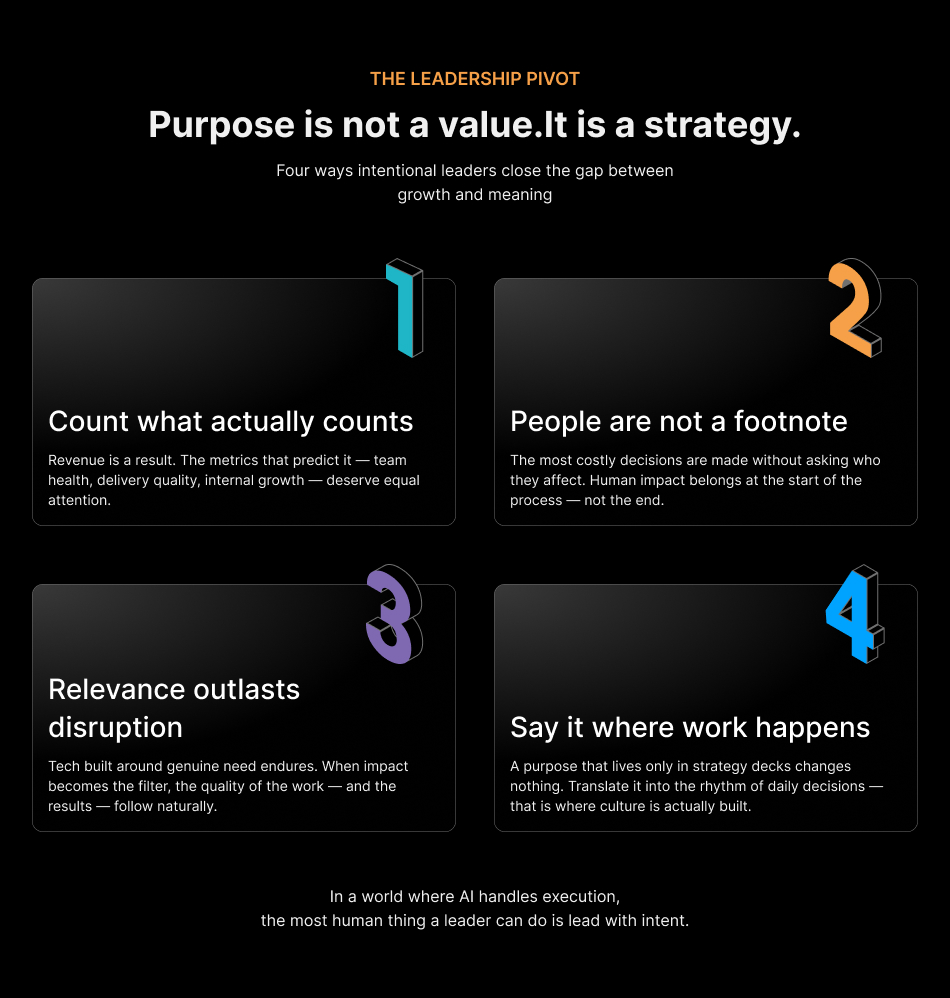
<h3>Actionable Insights</h3>Expand your scorecards beyond revenue to include purpose-driven metrics like impact, engagement, and retention. Make human impact a non-negotiable filter in every major decision, not a post-check. Align products and services with real user value—not just performance outcomes. Equip leaders to consistently communicate purpose in the context of daily work.
What Redefining Leadership Looks Like
Redefining leadership is no longer about authority or control—it’s about creating alignment between people, technology, and purpose. As AI takes over execution, leadership shifts toward enabling judgment, empathy, and meaning at scale. This means moving from managing performance to designing systems where people can do their best work.Because in a tech-driven world, leadership is defined not by decisions alone, but by how those decisions impact people.
People At The Core Of Strategy
I've sat in enough strategy sessions to know that "people are our greatest asset" has become the most reflexively spoken and least operationalized sentence in corporate life. Redefining leadership means making that statement structurally true—not rhetorically true.
That means people decisions get the same analytical rigor as product decisions. It means leadership succession is treated as a strategic priority, not an HR formality. It means when a high performer raises a concern about team culture, it gets to the table at the same level as a flagged metric in the business review.
People at the core of strategy means the org chart is built around enabling people, not controlling them.
Bridging Technology With Empathy
Here’s the tension I navigate constantly: I believe deeply in what technology can do—and I also believe deeply in what it cannot replace. As AI becomes more embedded in how we work, one thing is becoming increasingly clear: the value of empathy in leadership isn’t diminishing—it’s intensifying.
Bridging technology with empathy means using AI to surface data that helps leaders have better human conversations, not to replace those conversations. An algorithm can tell you someone is at flight risk, but only a leader with genuine care can have the conversation that changes their mind.
As systems get smarter, the human expectation doesn’t reduce—it rises. People don’t just want efficiency; they want to feel understood, seen, and valued. Our job as leaders isn’t to compete with that expectation—it’s to meet it.
Values In Everyday Decisions
Purpose-driven leadership isn’t lived in the annual strategy offsite. It’s lived in the moment when an account manager decides not to upsell a service the client doesn’t actually need. It’s lived when a development lead pushes back on a sprint deadline because the team hasn’t had the time to do the work properly. At ZealousWeb, it shows up in how we staff augmentation engagements—asking not just “do we have the technical resource available?” but “is this the right fit for what this client actually needs?” It is lived in the small, daily acts of choosing the harder right over the easier win.
Employees don’t evaluate culture based on what’s written on the website—they evaluate it based on the decisions they see being made around them. What gives people a sense of meaning isn’t the stated purpose; it’s whether that purpose consistently shows up in how teams operate, how trade-offs are made, and how leaders behave under pressure. That alignment—or its absence—is what they measure their leaders against every single day.
<h3>Actionable Insights</h3>Treat people decisions with the same rigor as business decisions, ensuring talent, culture, and leadership are part of core strategy. Use AI to enhance human understanding, not replace it—prioritize conversations over conclusions. Design systems and workflows that enable people to perform with clarity, ownership, and purpose. Most importantly, reinforce values through everyday decisions, because culture is shaped in actions, not statements.
Embedding Purpose Into Tech Strategy
Embedding purpose into strategy means ensuring that what the organization builds is consistently aligned with what it stands for. As technology accelerates execution, clarity of intent becomes critical to avoid misalignment at scale. This requires connecting strategic goals with shared values, not just at the leadership level but across teams. Because without alignment, even the best strategies fail to translate into meaningful outcomes.
Aligning Goals With Shared Values
Strategy documents are, by themselves, inert. What makes them come alive is whether the people building the product believe in what they're building. I've seen technically brilliant roadmaps fail because the team executing them didn't understand—or didn't believe in—the why behind them.
Aligning goals with shared values means that from the OKR to the all-hands to the one-on-one, the strategic direction and the human meaning of it are consistently connected. This takes repetition. It takes leaders who are willing to keep explaining the "why" long after they feel they've said it enough.
Designing Policies That Empower
Policies are silent culture-shapers. The leave policy tells people whether you trust them to be adults. The promotion criteria tell people what is actually valued, regardless of what the values poster says. The performance review process tells people whether they are a whole person or a set of KPIs.
When I evaluate organizational health, one of the first things I look at is the distance between stated purpose and actual policy. The closer they are, the more coherent the culture. The further apart they are, the more cognitive dissonance employees are being asked to carry—and that dissonance slowly drains engagement.
Gallup found that managers account for 70% of the variance in team engagement. That means the single highest-leverage policy decision any organization can make is investing in who it promotes into management and how it trains them.
Building Trust Through Transparency
Trust is built in small deposits and lost in large withdrawals. I’ve learned this the hard way. The quarter where leadership withholds a difficult truth to “protect” the team almost always ends with the team feeling more betrayed than they would have if they’d been told.
Transparency doesn’t mean broadcasting every strategic uncertainty. It means being honest about what you know, what you don’t, and what you’re doing about it. When people understand the context behind decisions—especially during change—they are far more willing to engage with it rather than resist it.
Transparency isn’t just an ethical stance. It is a change management strategy.
<h3>Actionable Insights</h3>Ensure strategic goals are consistently tied to a clear and communicated purpose across all levels. Design policies that reflect trust, empowerment, and what the organization truly values. Invest in leadership development, as managers are the primary drivers of engagement and culture. Build trust through transparency by openly communicating intent, decisions, and change.
Balancing Tech Growth With Human Connection
Balancing technology and human connection is about knowing what to scale and what to protect. As AI drives efficiency, leadership must ensure that empathy, judgment, and relationships are not diluted.The goal is not to replace human effort, but to augment it with better tools and sharper insights. Because sustainable growth comes from combining operational speed with meaningful human experience.
Efficiency Without Losing Empathy
Efficiency is a legitimate goal. I’m not arguing against it. But efficiency pursued without regard for the human experience of work creates organizations that are fast but hollow—places where people meet their metrics and feel nothing.
What we’re seeing in practice is that the real gains don’t come from removing humans from the loop—they come from augmenting them. When people use AI to support judgment, decision-making improves, context is preserved, and outcomes tend to be stronger than when systems operate in isolation.
The most efficient organizations I’ve worked with are the ones that have thought carefully about where efficiency should live. Automate the repetitive. Protect the relational.
Avoiding Pitfalls Of Over-Automation
There is a seductive logic to automation: if the machine can do it, let the machine do it. That logic works well for tasks that are truly transactional. It breaks down when applied to decisions that require context, nuance, or trust.
I've seen this play out in digital services firms specifically. Content marketing becomes AI-generated at volume, stripped of the genuine insight that made it worth reading. Web analytics dashboards multiply while the conversations about what the data means and for whom disappear. Client relationships — in areas like online reputation management or branding — get managed through templated processes that miss the human texture of what a client is actually anxious about. Automation scales output. It does not scale judgment.
The leaders who will navigate this era well are the ones who are deliberately, consciously protecting uniquely human skills — creativity, empathy, connection — within their organizations rather than automating around them.
Using AI And Data Responsibly
My view on AI in leadership is essentially this: use it to be better informed, not to abdicate judgment. The data tells you what happened. The human being in the room decides what to do about it.
In a company like ZealousWeb — where web analytics and e-commerce data analytics are services we provide to clients — this principle is especially important to live by internally. We have access to more data about campaign performance, user behaviour, and conversion patterns than ever before. That data is only as valuable as the quality of thinking applied to it. When a PPC campaign underperforms, the data flags it. The human strategist asks why, with all the context that the data alone cannot carry.
Research suggests that organizations investing in responsible AI practices are better positioned to innovate effectively and sustainably. Governance and performance aren’t in tension. Organizations that ask hard questions about how their AI behaves tend to be the ones that also build better products and services.
Using data responsibly means resisting the temptation to hide behind it. The number doesn't make the decision. You do.
<h3>Actionable Insights</h3>Automate repetitive tasks while intentionally preserving human-led interactions where judgment and trust matter. Ensure AI is used to support decision-making, not replace it. Regularly evaluate where over-automation may be impacting quality, creativity, or relationships. Build systems where data informs actions, but human context drives decisions.
Use Case: Scaling Purpose Across AI-Enabled Teams
Understanding purpose as a leadership principle is one thing. Putting it to work inside a growing, AI-enabled organisation is another. This use case illustrates what that looks like in practice — and why the agencies that get it right treat culture not as something to protect, but as something to deliberately build into the way work gets done.
Scenario
Imagine an agency that has tripled its team in under two years. AI tools are now embedded across delivery, reporting, and client communication. Commercially, everything looks strong — retention is up, revenue is growing, and the team is executing well.
Challenge
A few months into the growth, something quietly shifts. New hires are absorbing the process but not the principles behind it. AI is handling more of the execution but carrying none of the judgment. The culture that once held everything together — the way the agency thought, decided, and worked — is no longer something people simply pick up by being in the room.
Approach
Leadership stops leaving culture to chance and starts building purpose into the infrastructure. How briefs are written, how AI tools are configured, how decisions are communicated across distributed teams — all of it becomes intentional. Alignment shifts from an annual assumption to a recurring leadership rhythm.
Outcome
Teams across locations move with shared clarity — not just shared tools. New hires understand how the agency thinks before they finish their first month. AI workflows feel like a natural extension of the agency's values rather than a departure from them. The culture does not just survive the growth. It scales with it.
Purpose-Driven Leadership Readiness Framework
Knowing where to start is half the challenge. Most leadership teams have a sense that something needs attention — but without a structured way to look at it, the conversation either stays surface-level or never happens at all.
This self-assessment framework gives leadership teams in tech-driven environments a practical, honest way to evaluate where purpose is already embedded in how the organisation operates — and where the gaps are most likely to show up as the business grows, adopts AI tools, or scales across distributed teams.
It covers five areas that consistently separate purpose-led organisations from ones that simply talk about purpose: purpose clarity, decision-making, employee experience, ethical AI use, and cultural alignment. Each area takes less than two minutes to work through — making the full assessment completable in under ten minutes, individually or as a leadership team exercise.
Living Purpose In Tech Leadership
Living purpose in leadership is about translating intent into everyday behavior.
In a technology-driven environment, this means ensuring that decisions, interactions, and priorities consistently reflect what the organization stands for. It’s not built through occasional alignment, but through repeated, intentional actions over time. Because ultimately, purpose is not communicated through statements—it is experienced through leadership in practice.
Turning Purpose Into Daily Practice
Purpose is not a quarterly review item. It is a daily practice — or it is nothing.
For me, turning purpose into practice has looked like specific, repeatable behaviors: beginning every team meeting with a brief check-in that isn't about work. Blocking calendar time for one-on-ones that aren't status updates but actual conversations. Reading the qualitative comments in engagement surveys, not just the aggregate scores. Writing down, at the start of the week, whose development I am actively responsible for — and then actually doing something about it. In a company where our teams span everything from Shopify developers to SEO strategists to data analysts, that kind of intentionality doesn't happen by default. It requires the leader to build it as a practice, deliberately, on repeat.
None of these are grand gestures. Purpose lived at the leadership level is almost always small-scale and consistent. It is the 100th time you say "here's why this work matters" that people finally believe you mean it.
Inspiring Through Consistent Action
People don't follow vision statements. They follow people who consistently behave in alignment with what they say they believe. The gap between stated values and daily behavior is the trust gap—and it's measured in real time by every person who reports to you.
Research on employee engagement consistently shows that confidence in leadership is one of the strongest drivers of engagement. Not perks, not pay, not remote flexibility—confidence in leaders. That confidence is built in the accumulated weight of consistent action over time.
Inspiration is not a speech. It is a pattern of behavior that people observe until it becomes something they trust.
Building A Human-Centered Legacy
I think about legacy differently than I used to. Early in my career, legacy meant the products I had shipped, the companies I had helped scale, the metrics I could point to on a slide. Those things still matter to me. But increasingly, the legacy I am most interested in is about people.
Did the teams I led develop leaders who went on to build something meaningful? Did the culture I shaped give people the conditions to do the best work of their career? Did someone leave a conversation with me feeling more capable than when they walked in?
A human-centered legacy is not about erasing commercial ambition. It is about understanding that the deepest measure of a leader's impact is the people they helped become—not just the businesses they helped build.
<h3>Actionable Insights</h3>Translate purpose into repeatable leadership behaviors—embed it into meetings, one-on-ones, and decision-making rituals. Focus on consistency over intensity, as trust is built through small actions done repeatedly over time. Close the gap between stated values and actual behavior by holding yourself accountable in everyday interactions. Measure leadership impact not just by outcomes, but by how teams grow, engage, and perform under your guidance.
Conclusion
If I were to distill everything in this article into the things I believe most firmly, it is this: purpose is not a moral luxury for leaders who can afford it. It is a competitive necessity — one that drives retention, innovation, trust, and long-term growth. The evidence is increasingly clear: human-centered organizations outperform, outlast, and out-retain their peers.
Human-centered leadership is not softer than traditional leadership. It is more demanding, because it requires you to hold people in mind at every decision point, not just when it's convenient. And technology amplifies everything — including your values. If your values are extractive, technology scales extraction. If your values are generative, technology scales that instead. Purpose endures because it connects technology to what fundamentally drives people—meaning, belonging, and impact.
And in a world of accelerating change, the leaders who consistently center that human question are the ones who build organizations that people don’t just join—but truly believe in. At ZealousWeb, this conviction isn't decorative. It shapes how we build teams, how we serve clients, how we approach the work of digital transformation and growth alongside the people and businesses we partner with. The tools will keep getting smarter. The question of what we do with them — who benefits, who is protected, who is seen — remains ours to answer.
FAQs
How do you lead a team that's increasingly working alongside AI tools without losing the human culture you've built?

The instinct is often to focus on the tools themselves — which ones to adopt, how fast to roll them out. But the more important question is what you're asking people to do alongside those tools. When AI handles more of the execution, the human contribution shifts toward judgment, context, and meaning. That shift only goes well if people understand why the work matters — not just what the workflow looks like. Culture doesn't erode because AI arrived; it erodes when leaders stop explaining the "why" behind decisions and assume the team will fill in the gaps themselves.
With AI handling more execution, what is the actual role of a leader today?
As AI takes over repetitive and even analytical tasks, leadership shifts toward something machines can't replicate: intent, judgment, and meaning. An algorithm can flag that someone is disengaged or that a campaign is underperforming — but only a leader can ask the right question, have the right conversation, and make a decision that accounts for context the data doesn't carry. The role isn't shrinking; it's becoming more distinctly human.
How do you measure purpose in a business — it seems intangible?
It becomes tangible when you expand what you track. Alongside commercial metrics, consider: What percentage of your team feels their work has genuine impact? How many internal promotions are you making versus external hires? What does your attrition look like among high performers in their first two years? These aren't soft metrics — in a services business especially, they are leading indicators of delivery quality and client outcomes. Purpose shows up in retention numbers, in NPS trends, and in how teams perform under pressure.
What's the biggest mistake leaders make when introducing AI into their teams?
Over-automating without protecting judgment. There's a seductive logic to "if the machine can do it, let the machine do it" — but that breaks down wherever context, nuance, or trust is involved. Content loses its genuine insight. Client relationships get managed through templates that miss what someone is actually anxious about. Automation scales output; it does not scale judgment. The leaders who navigate this well are the ones deliberately protecting creative, empathetic, and relational work from being automated away.
Why do so many organizations talk about culture and engagement but never actually move the needle?
Because most organizations treat engagement as an HR program rather than a leadership responsibility. The problem rarely lives in the policy document or the values poster — it lives in the gap between what leaders say they believe and how they actually behave day to day. Culture is shaped in small, repeated decisions: who gets promoted, how difficult conversations are handled, whether the "why" behind a decision is ever explained. Until leaders close that gap consistently, no initiative will move the needle in any meaningful way.
